Halogenation of alkane
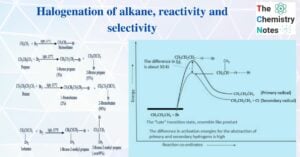
Halogenation of alkane involves the replacement of one or more hydrogen atoms in organic compounds by halogen atoms (like F, Cl, Br, I). It is the simple substitution reaction in which a C – H bond is broken and a … Read more
Chemistry is the study of elements (such as atoms, molecules, compounds, ions, and so on) and their chemical composition, properties, structure, and chemical reactions.
Halogenation of alkane involves the replacement of one or more hydrogen atoms in organic compounds by halogen atoms (like F, Cl, Br, I). It is the simple substitution reaction in which a C – H bond is broken and a … Read more
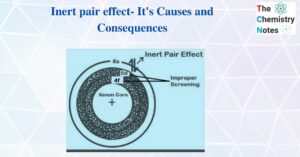
The p-block elements with higher atomic numbers [e.g., Ga, In, Tl (Gr IIIA), Ge, Sn, Pb (Gr IVA), and As, Sb, Bi (Gr VA)], display two oxidation states they are: Higher oxidation states (Group oxidation states) These are equal to … Read more
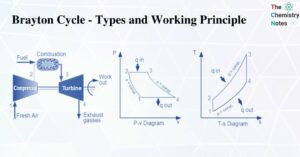
One of the most prevalent thermodynamic cycles found in gas turbine power plants or aircraft is the Brayton cycle. There are two broad categories of thermodynamic cycles: power cycles, which generate a net power output, and refrigeration and heat pump … Read more
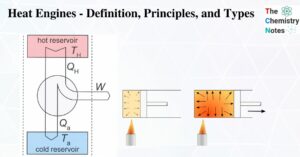
A heat engine draws heat from a source and uses it to create mechanical work for a variety of purposes. For instance, a steam engine on an antique train can generate the necessary work to propel the vehicle. The role … Read more
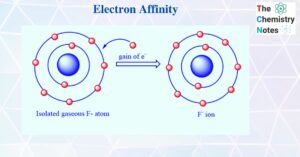
Electron affinity is the energy released when an electron is added to a neutral, gaseous, and isolated atom in its ground state to form a monovalent anion. It is a quantitative measurement of the energy change caused by adding a … Read more
Thermodynamics is the branch of physics that studies the relationship between heat and other properties of a substance (such as pressure, density, temperature, and so on). Thermodynamics, in particular, focuses on how heat transfer is related to various energy changes … Read more
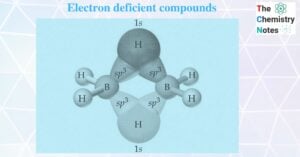
These are the compounds in which the central atom lacks eight electrons in its valence shell or possesses eight electrons but can expand the valency due to the presence of valence d-orbital. In short, electron-deficient compounds lack the electrons required … Read more
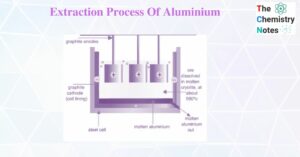
Aluminium is a noncorrosive lightweight silvery-white metal. It is included in the boron group (Group III a) in the periodic table. Aluminium is the most abundant metallic element on earth accounting for about 8% of the earth’s crust. It can … Read more
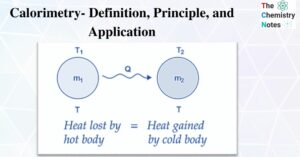
Calorimetry is the science of measuring the heat exchange between a system and its surroundings to calculate the change in energy of the system. The word Calorimetry is derived from the Latin calor (“heat”) and Greek metron (“measure”), and so … Read more