Bleaching Agents: Types, Mechanism, Application

Bleaching Agents

Bleaching agents are the chemicals that lighten or whiten substances by dissolving colored substances or by changing its light-absorbing properties. Bleaching agents are commonly used in the paper and pulp industry, the textile industry, and the commercial and household laundering. … Read more

Bond Cleavage: Homolysis and Heterolysis

Bond Cleavage

Bond cleavage is the dissolution of a chemical bond (usually a covalent bond). Covalent bond fission, or covalent bond breaking, can occur in two ways: i.e., Homolytic bond cleavage and Heterolytic bond cleavage. Homolytic bond cleavage Homolysis, also known as … Read more

Salt: Preparation, Properties, Types, Uses

Salt

Salt is defined in chemistry as an inorganic or organic molecule with ionic bonding. When dissolved in water, ions break down into positively charged cations and negatively charged anions. Positive ions (cations) and negative ions (anions) make up salts. Because a … Read more

Acidic Strength of Carboxylic Acids

Factors Affecting Acidic Strength of Carboxylic Acids

Several factors influence the acidic strength of carboxylic acids. These factors are classified as structural and environmental. Factors Affecting Acidic Strength of Carboxylic Acids The acidic strength of carboxylic acids can be affected by the solvent used. Carboxylic acids tend … Read more

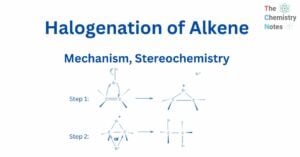
Halogenation of Alkene: Mechanism, Stereochemistry

Halogenation of alkene

Halogenation of alkene involves the addition of a halogen such as bromine or chlorine to an alkene’s double bond. Because of the polarizability of their covalent bond, halogens can act as electrophiles. Halogen addition is stereospecific, producing vicinal dihalides with anti-addition. … Read more