Skip to content
Science Info
  • Home
  • All Study Notes
  • Astronomy
  • Physics
  • Chemistry
    • Periodic Table
    • Analytical Chemistry
    • Basic Chemistry
    • Biochemistry
    • Computational Chemistry
    • Environmental Chemistry
    • Inorganic Chemistry
    • Nanochemistry
    • Organic Chemistry
    • Pharmaceutical Chemistry
    • Physical Chemistry
  • Biology
    • Animals
    • Plants
  • Microbes
    • Bacteria
    • Viruses

Periodic Table

The periodic table is an arrangement of all known elements in order of increasing atomic number and recurring chemical properties. 

  • To facilitate the study of elements, all known elements must be arranged according to their properties, with related elements falling into the same groups and dissimilar elements being separated. This process is known as element classification.
  • The Mendeleev periodic table, an earlier version of the periodic table, was based on the law that “Physical and chemical properties of elements are the periodic function of their atomic masses”.
  • Mendeleev’s (1861) scientific classification of chemical elements based on their masses or atomic weights has been disproved, leading to the development of the modern periodic table law.
  • The Modern periodic table, long form of the periodic table, is based on the law that “Physical and chemical properties of elements are the periodic function of their atomic numbers”.
  • The classification of elements in the long version of the periodic table is based on the order of increasing atomic numbers or Periodicity (i.e., periodic repetition of attributes).
  • Periodicity is the recurrence of similar-behaving elements at regular intervals when these elements are grouped in ascending order of their atomic numbers.
  • There are 18 vertical columns of elements known as groups and seven horizontal rows of elements known as seven periods. The modern periodic table, therefore, contains 18 groups, which are numbered from 1 to 18.
  • The periodic table contains interesting facts that clearly illustrate the relationship between electronic structure and periodic accommodation capacity as the purpose of chemical elements.
  • The atomic structure or the electrical arrangement of an element determines its periodicity.
  • As a result, the recurrence of comparable features results from repeated electrical configurations or atomic structures. Thus, the repetition of an analogous electrical arrangement is the cause of periodicity.
  • The many kinds of metals and non-metals in chemistry are arranged into the s, p, d, and f-block on the periodic table by the modern periodic law, which is based on the atomic number and valence shell electron configuration of elements.
  • s- block elements: The arrangement of electrons in the periodic table gives rise to the designation “s-block element” in which the valence electron enters the ns-orbital and gradually fills it by the configuration rules. S-block elements are the 1st and 2nd group elements.
  • p-block elements: The last electron in a P block element enters one of the three p-orbitals of its corresponding shell. As a p-subshell has three degenerate p-orbitals, each of which may hold two electrons, there are six groups of p-block elements. P-block elements are those that belong to groups 13 to 18. ns2 np1-6 is the general electrical configuration for these elements.
  • d-block elements: d-block elements are those that are found from Group 3 to Group 12 in the middle of the periodic table. Because the final electron gets to the d-orbital of the penultimate shell, they are known as a “d-block” element.
  • f-block elements: The f-block elements, also known as inner transition elements, are those whose final electron to enter the f-orbital is known. In addition to having electrons in the outermost orbital, these elements also have electrons (0 to 1) in the penultimate energy level’s d orbital and (1 to 14) in the f orbital. In the f-block, there are mainly two series that correspond to the filling of the 4f and 5f orbitals.

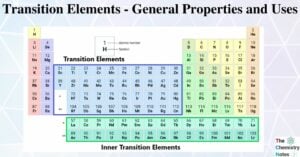
Transition Elements – General Properties and Uses
December 18, 2022 by Jyoti Bashyal
Transition Elements - General Properties and Uses

The transition metals, which are located in the middle of the periodic table, make up the largest group of elements there. Additionally, the lanthanides and actinides, two rows of elements below the main body of the periodic table, are particular … Read more
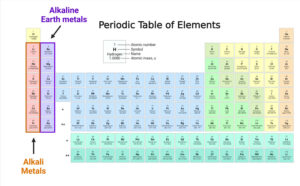
Periodic Table – Multiple Choice Questions (MCQ)

December 16, 2022 by Jyoti Bashyal
Periodic Table Multiple Choice Questions (MCQ)

A. How many periods and groups are present in the periodic table? Answer: 1 Modern periodic table consists of 7 horizontal rows known as periods and 18 vertical columns named as groups. B.  What is the other name for group 18th elements? … Read more

Comparison of properties of Alkali and Alkaline Earth Metals

November 28, 2022October 3, 2022 by Kabita Sharma
Alkali and Alkaline Earth Metals

What are Alkali metals? Elements of group IA are called alkali metals. The word alkali is derived from the Arabic word alquli, meaning ashes of plants, because the plant ashes are particularly rich in sodium and potassium carbonates. In the … Read more

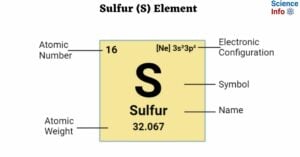
Sulfur (S) Element- History, Properties, Uses, Reactions, Safety

April 23, 2024August 22, 2022 by Jyoti Bashyal
Sulfur (S) Element

Sulfur is multivalent non-metal, abundant, and odorless. Pure sulfur is a tasteless, odorless, brittle, pale yellow solid that is a poor conductor of electricity and insoluble in water. It can be found in nature as a pure element or as … Read more

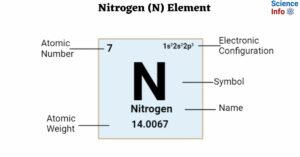
Nitrogen Element- Definition, Occurrence, Properties, Uses, Effects

March 27, 2024July 21, 2022 by Jyoti Bashyal
Nitrogen (N) Element

The element Nitrogen belongs to Periodic Table Group 15. It is a nonmetallic element that accounts for approximately 78 percent of the Earth’s atmosphere. It exists in the form of diatomic molecules, N2. The gas is inert due to a … Read more

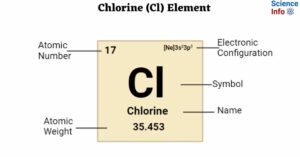
Chlorine Element- Definition, Properties, Reactions, Uses, Effects

March 27, 2024July 20, 2022 by Jyoti Bashyal
Chlorine (Cl) Element

The element Chlorine is the halogen located in group 17 in the periodic table. Chlorine is the chemical element that constitutes about 0.017 percent of the earth’s crust. Chlorine is a toxic, corrosive gas that is greenish-yellow and irritating to … Read more

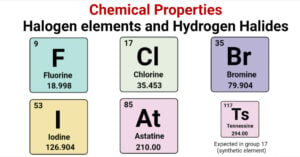
Chemical Properties of Halogen Elements and Hydrogen Halides

August 16, 2022July 20, 2022 by Jyoti Bashyal
Chemical Properties of Halogen Elements and Hydrogen Halides

Group 17 of the periodic table is named Halogens as they all produce sodium salts with similar properties. The chemical properties of halogens [ fluorine (F), chlorine (Cl), bromine (Br), and iodine (I)] are summarized below. Oxidizing Properties of Halogen … Read more

Reactions of Halide Ions (with sulphuric acid, silver nitrate, ammonia)

March 2, 2024July 20, 2022 by Jyoti Bashyal
Reactions of Halide Ions

A halide ions is a negatively charged anion formed by a halogen atom. They have a (-1 ) charge. A halide is also a compound composed of a halogen atom bonded to a less electronegative species. Halide Ions include fluoride … Read more

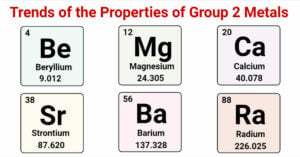
Trends of the Properties of Group 2 (Alkaline Earth) Metals

July 20, 2022 by Jyoti Bashyal
Trends of the Properties of Group 2 Metals (Alkaline Earth Metals)

Group 2 elements (alkaline earth metals) all have two electrons in their outermost principal quantum shell. All Group 2 metals can form ionic compounds in which they donate their two outermost electrons (acting as reducing agents) to form a +2 … Read more

Older posts
Newer posts
← Previous Page1 … Page13 Page14 Page15 Next →

Topics

  • Analytical Chemistry (164)
  • Animals (2)
  • Astronomy (4)
  • Bacteria (9)
  • Basic Chemistry (144)
  • Biochemistry (38)
  • Biotechnology (2)
  • Book Reviews (1)
  • Botany (2)
  • Computational Chemistry (4)
  • Differences Between (70)
  • Environmental Chemistry (31)
  • Events (2)
  • Inorganic Chemistry (183)
  • Journals (1)
  • Medical Devices (1)
  • Nanochemistry (17)
  • Organic Chemistry (177)
  • Periodic Table (130)
  • Pharmaceutical Chemistry (15)
  • Physical Chemistry (199)
  • Physics (94)
  • Plants (13)
  • Science Facts (12)
  • Syllabus (5)
  • Top 10 in Science (14)
  • Universities (4)
  • Viruses (2)
  • Zoology (1)
  • Quality Control vs. Quality Assurance in Medical Devices 
  • Gene Cloning and Recombinant DNA Technology
  • Polymerase Chain Reaction (PCR): Principle, Procedure, Types, Uses
  • Vibrio cholerae: A Comprehensive Guide
  • Listeria monocytogenes: A Comprehensive Guide
  • About
  • Our Team
  • Contact Us
  • Editorial Policy
  • Privacy Policy
  • Cookie Policy
  • Disclaimer (Terms and Conditions)
© 2026 Science Info. Made with ♡ by Sagar Aryal.