Lever (Simple Machine): Parts, Principle, Classes, Examples, Applications
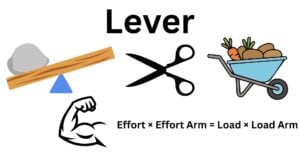
Introduction to Lever (Simple Machine) A lever is the first simple machine tool designed in ancient times. Since simple machines are used to finish our work easily and use less manual force, they were designed by the ancestors during the … Read more

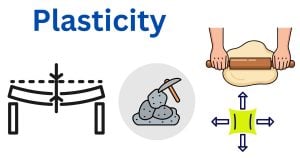
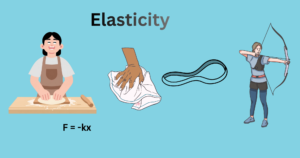
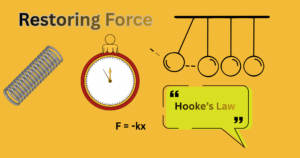
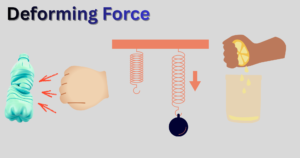
![Elasticity vs. Plasticity: Definition, Differences, Examples What is Elasticity? Elasticity and plasticity are to contradicting properties of any material. The same material can show both properties, but under different conditions. Thus, what is the difference between these two terms? Let's study them briefly below. To understand elasticity and plasticity, first, we have to know about the deforming force. Deforming forces are the forces applied externally to any material, either soft or rigid. These forces bring a physical change (visible or microscopic) to that object. Hereafter, we deal with the properties of that material, either elastic or plastic, after removing the deforming force. We define elasticity as the property of any material that can return to its original form after the force is removed. For example, when we pull the rubber of a catapult, it stretches, but as it is released, it comes to its initial shape. This behavior of a catapult can be called the elastic behavior. Elasticity is not a vague or unnatural property. Since every object is made up of atoms and molecules, the arrangement of those atoms gets disturbed when a force is applied. If the force is not very strong, the atoms can go back to their regular arrangement after the force is removed. Thus, a small change always occurs when a force is given. The atoms also have a potential energy stored on them when force is applied, so that they can regain their initial shape when the force is removed. Hence, elasticity is a natural or fundamental property of a material. While studying elasticity more precisely, we find that there is a certain point at which an object can restrict the deforming force and regain its original shape. This limit is called the elastic limit and is described by Hooke’s law. According to Hooke’s law, within the elastic limit, the stress applied to any object is directly proportional to the strain developed. Stress ∝ Strain [Equation 1] The study of elasticity is very important in physics to determine the strength of any material. Many constructions are done in engineering and structural designs under the study of elasticity. What is Plasticity? Above, we describe only the case within the elastic limit. Now, what happens when the elastic limit is overcome? The answer is that the strain on that object becomes permanent. The object no longer remains elastic and hence is called the plasticity of that object. Hence, plasticity is a condition obtained when the deforming force is so large that it exceeds the elastic limit and creates a permanent change in the shape, size, or dimension of an object. The internal arrangement of atoms breaks down, and hence they don’t have sufficient potential energy to withstand the force given. In everyday life, crush a mineral water bottle after finishing the water in it. The bottle now becomes different in shape after being crushed and never returns to its original good condition. This is the case of plasticity. Elasticity and plasticity both depend on the nature of the material and the surrounding conditions. The elastic limit is different for different materials, and hence they behave accordingly. Thus, the elastic limit plays a great role in defining elasticity and plasticity. However, no object is ideally elastic in nature. Some materials can have an invisible change in their shape. Temperature also plays a great role in changing an elastic object into a plastic object. Both properties have their own importance. We use both of them as per our need; elasticity is not always what we need, nor is plasticity that bad. Elasticity vs. Plasticity (Table Form) Feature Elasticity Plasticity Definition Ability to regain the original shape after force Ability to undergo permanent deformation Nature of Deformation Temporary Permanent Reversibility Reversible Irreversible Elastic Limit Exists (valid up to this point) Begins beyond the elastic limit Atomic Behavior Atoms return to their original positions Atoms shift to new positions permanently Energy Behavior Energy stored and released Energy is dissipated as heat or internal changes Examples Rubber band, spring, steel (within limit) Clay, wax, bent metal Application Springs, bridges, elastic structures Metal shaping, molding, and forging Failure Type Returns or breaks if limit exceeded Deforms without returning Stress-Strain Curve Region Linear region Non-linear region Examples of Elasticity Rubber Band A rubber band is probably the easiest way to understand elasticity. You stretch it, and it stretches. You release it, and it goes back. This simple action clearly shows elastic behavior. Springs Springs are designed specifically to use elasticity. Whether it’s in a pen, a car suspension system, or a mattress, springs compress and expand while returning to their original shape. Rods and Steels in Constructions In large structures such as bridges or tall buildings, steel beams and rods are used. They can slightly bend under heavy loads like wind or traffic. But once the load is removed, they return to their original position. Bouncing Ball A ball bounces back after hitting the ground. This is due to the elasticity of the ball. The more elastic the material, the more it bounces. Elastic Fabrics When elastic fabrics are used in our clothes, they can stretch as per the needs of our body and hence make our attire flexible. Examples of Plasticity Plasticity is equally important and is often more visible in shaping and forming materials: Clay Clay is one of the best examples of plasticity. It can be shaped into anything—from pots to sculptures—and it keeps that shape permanently. Bent Metal If we bend a metal wire with a small force, it can come to its original shape after removing our force. But we bend it harder, and it stays bent. This is plastic deformation. Wax Wax can be easily reshaped when force is applied. Once molded, it does not go back to its original form. Metal Forging In industries, metals are heated and hammered into different shapes. This process depends on plasticity. Car Body Damage During accidents, car bodies often get dented. This is also an example of plastic deformation. Dough When you knead dough, it doesn’t go back to how it was before. This shows plastic behavior. Conclusion Elasticity and plasticity come together in practice. We should only know how to differentiate them from the same material. No matter where on earth is untouchable from these two properties. One talks about the ability to recover, while the other flows with the change. As one finishes, the other approaches. The barrier between the two entities is the deforming force. The elastic limit is the point to note to see both behaviors in the same material. Basically, every object is elastic in the beginning, but gradually, when the force is increased, the elasticity gets disrupted. In constructions like buildings and bridges, the natural forces of disasters and loads are assumed first, and are built to make them elastic to withstand such forces. However, in crushers, pressing machines, shape builders, and mixtures, the elastic limit is studied first, and the force is applied to deform the materials permanently. Both properties are equally valued. Elasticity ensures safety and flexibility in structures, while plasticity allows us to shape and manufacture useful objects. Together, they help us design everything from simple tools to complex machines. Understanding elasticity and plasticity helps us make better decisions in real-life situations. All the natural phenomena can be studied under the same roof of elasticity and plasticity. Elasticity Vs. Plasticity](https://scienceinfo.com/wp-content/uploads/2026/03/Elasticity-Vs.-Plasticity-300x158.jpg)