Qualitative Salt Analysis: Common Ion Effect

Qualitative salt analysis

Qualitative salt analysis is the process of determining the number of constituents present in an unknown salt sample. The common ion effect is most commonly used in the salt analysis, i.e. qualitative analysis of basic radicals (in group separation). In qualitative … Read more

Common ion effect: Important Applications

Common ion effect

Common ion effect refers to the suppression of a weak electrolyte’s degree of ionization by the addition of a strong electrolyte that shares one ion with it.   Therefore, the common ion effect is used whenever it is necessary to prevent the … Read more

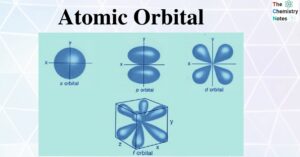
Atomic Orbital

Atomic Orbital

The term ‘atomic orbital’ refers to the physical space or region around an atom’s nucleus where the probability of a specific electron being present is greatest. The mathematical representation of the atomic orbital predicts the presence of an electron in … Read more

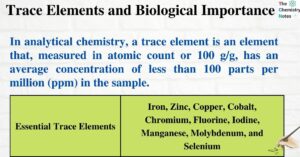
Trace Elements and Biological Importance

Trace Elements and Biological Importance

Trace elements are any chemical elements found in trace amounts in the body. Trace elements can be categorized as potentially toxic, likely essential, or nutritionally essential. The nutritionally necessary components are necessary for proper metabolic and physiological processes. The human … Read more

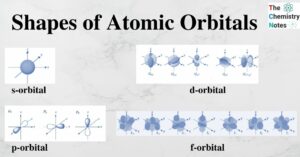
Shapes of Atomic Orbitals

Shapes of Atomic Orbitals

Different atomic orbitals have different shapes. In other words, they describe different probability distributions for the electrons that surround the nucleus. One of the reasons why orbitals vary in energy is because the electrons in various orbitals are likely to … Read more

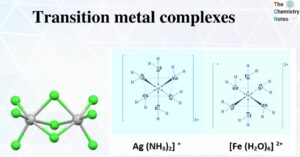
Transition metal complexes- Complex Ion Formation

Transition metal complexes

Transition metal complexes, also known as coordination complexes, are molecules with groups organized around a central metal ion. In some ways, these are similar to “lego-molecules,” as they can be easily constructed from smaller pieces and sometimes converted into new … Read more

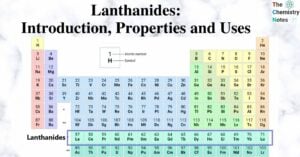
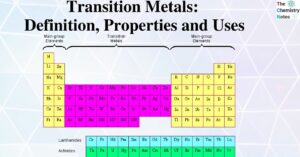
Transition Metals: Definition, Properties and Uses

Transition Metals Definition, Properties and Uses

The periodic table elements are frequently classified into four groups: (1) main group elements, (2) transition metals, (3) lanthanides, and (4) actinides. Transition elements are elements found in Groups 3-12 of the periodic table (old groups IIA-IIB). The word refers … Read more