Gibbs Free Energy and Helmholtz Free Energy

Gibbs Free Energy and Helmholtz Free Energy

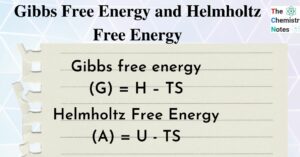
In thermodynamics, free energy is an energy-like characteristic or a state function of a system that is in thermodynamic equilibrium.  How systems adapt and how much work they can produce are both determined by free energy. The Gibbs free energy … Read more

Thermodynamics -Multiple Choice Questions(MCQ)

Thermodynamics Multiple Choice Questions (MCQ)

a) Conservation of energyb) Conservation of mass c) Conservation of momentum d) Conservation of work Answer: a The conservation of energy is the foundation of the first law of thermodynamics, as explained. It deals with the labor performed and the … Read more

Difference Between Adsorption and Absorption

Differences between adsorption and absorption

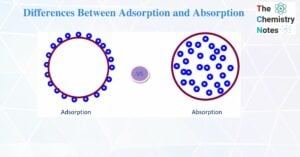
Adsorption Adsorption is a surface phenomenon that involves the accumulation of molecular species on the surface rather than within the bulk of a solid or liquid. Adsorbate is the substance that accumulates on the surface of another substance. For instance, … Read more

Le-Chatelier’s Principle

Le-Chatelier's Principle

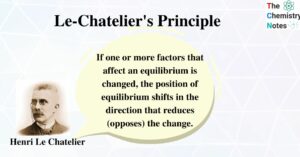
The Le Chatelier’s principle is one of the key ideas in chemical equilibrium. It enables us to forecast how an equilibrium system will behave in diverse situations. Changes in both concentration and temperature affect the position of equilibrium. When any … Read more

Adsorption, It’s types and applications

Adsorption

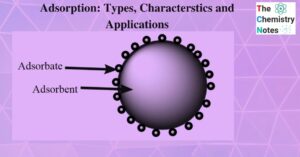
Adsorption is a surface phenomenon that involves the accumulation of molecular species on the surface rather than within the bulk of a solid or liquid. A substance that accumulates on the surface of another substance is called adsorbate. For instance, … Read more