
Introduction and Definition of Solar Water Heater
A solar water heater is a heating device based on solar energy. In the past, we used fire from wood or gas stoves to boil water. After the development of technology, induction and electric jug/kettle were brought into use. Keeping in mind the impacts brought by conventional methods, technologies are now evolving from renewable sources of energy. Such technology is a solar water heater, which heats water by getting energy directly from the sun and converting it into heat energy.
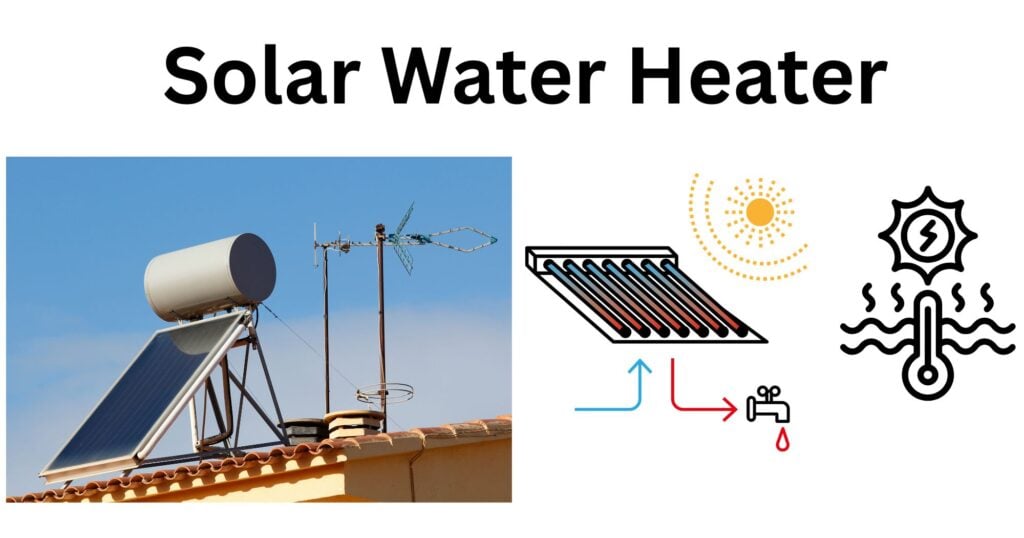
A solar water heater is used to heat water for small household purposes and for massive industrial and business purposes. It is a very secure, safe, and reliable method for heating water. It causes no harm to the environment and also has no risk to the personnel.
Conventional energy sources are costly, limited, and have to be saved for the future. Moreover, the risk of environmental degradation is also high. In this case, the need for a sustainable method is a major requirement. This requirement is mostly fulfilled by the use of solar energy. Solar water heaters absorb the solar energy and convert it into heat. The trapped heat inside the heater helps to warm the water. It is a very suitable method for everyday use.
Principle and Working of Solar Water Heater
Solar water heaters are based on the principle of energy conversion. It is based on solar energy harvesting. The solar energy is directly converted into thermal energy (heat energy).
The sunlight is allowed to fall on the solar collector. It absorbs the sunlight and converts it into heat. This heat is allowed to pass to the water flowing through pipes or tubes inside the collector. The heat is trapped inside, and slowly the temperature starts increasing. Gradually, the water gets heated. It is now allowed to move into an insulated storage tank. The water is stored in the tank and used when needed. This movement to the tank is natural because hot water is naturally lighter than cold water. This process is also called thermosiphon circulation.
In very active systems, pumps are used for this circulation between the collector and the tank. The solar collector keeps collecting the light during the daytime, and the insulated storage tank does not allow heat to flow to the outer surroundings. This keeps the water warm for several hours. Thus, solar water heaters are 100% dependent on the Sun to heat water efficiently.
Types of Solar Water Heaters (Active and Passive Systems)
There are two basic types of solar water heaters, which are given below:
Active Solar Water Heaters
Pumps are used in active solar water heaters. The water is circulated from the collector to the tank through these pumps. Controllers are also used to guide the flow of water. Finally, the water in the tank is heated by the heat obtained in the collector.
Since pumps and controllers are used, the water circulation and heat transfer are more organized in active systems.
Active systems are also of two types:
- Direct circulation systems
- Indirect circulation systems
Direct systems circulate water directly through the collectors, while indirect systems use a separate heat-transfer fluid.
Passive Solar Water Heaters
Passive systems are made without pumps and controllers. Water circulation occurs naturally through thermosiphon action or gravity.
These systems are simpler than active systems and are also less expensive. They also require less maintenance from time to time.
Common passive systems include:
- Thermosiphon systems
- Integral collector-storage systems
Passive systems are easier to use and more affordable. Hence, they are very popular in common places.
Structure and Components of a Solar Water Heating System
The various components of solar water heating systems are as follows:
Solar Collector
Solar collectors are light-collecting surfaces. They absorb sunlight and convert it into heat.
Storage Tank
The storage tank is a water-storing surface. It stores the heated water for a longer period of time.
Pipes and Tubes
Pipes carry heated water from the collector to the storage tank.
Insulation
Insulation is done so that heat doesn’t flow outside, and the hotness of the water is preserved. This is important so that we can use the hot water when needed.
Support Structure
The support structure fixes the position of the collectors so that maximum light gets collected on them.
Pump (in Active Systems)
Pumps circulate water or heat-transfer fluid in active systems.
Controller
Controllers are also used in active systems to control the flow of water in pumps.
All these components are equally important to build an efficient and reliable solar water heating system.
How Solar Collectors Heat Water (Flat Plate and Evacuated Tube)
Solar collectors are the heart of a solar water heating system. Two common types are flat plate collectors and evacuated tube collectors.
Flat Plate Collectors
Flat plate collectors consist of:
- A transparent glass cover
- An absorber plate
- Water-carrying tubes
- Insulation
Sunlight passes through the glass cover and strikes the absorber plate. The absorber is black in color, as black color absorbs the maximum amount of light. The absorber traps the light and convert into heat.
The absorber is attached to the tube where water flows. As heat is trapped in the absorber, the temperature of the water rises slowly and is heated. The insulation is done so that heat cannot escape to the surroundings.
Flat plate collectors are durable, reliable, and common for household purposes.
Evacuated Tube Collectors
Evacuated tube collectors are made up of several glass tubes that contain an absorber. The tubes are arranged in parallel. Each absorber is surrounded by a vacuum. The vacuum is created so that heat cannot flow out.
As the sunlight enters the tube, it heats the absorber. The heat is then transferred to water or a heat-transfer fluid.
Evacuated tube collectors are more efficient in cold climates and cloudy conditions.
Factors Affecting the Efficiency of Solar Water Heaters
The efficiency of a solar water heater depends on several factors.
Intensity of Sunlight
High intensity of sunlight increases the amount of heat generated. Cloudy weather hampers the performance of the system.
Collector Area
Larger collectors are able to absorb more solar energy. Thus, a great amount of energy is generated.
Orientation Toward the Sun
Proper alignment of the collector towards the Sun can help to collect enough sunlight for heating.
Ambient Temperature
Higher surrounding temperatures improve the performance of solar cookers.
Good Insulation
Good insulation quality reduces the chances of heat loss from the components, and the temperature remains stable inside.
Weather Conditions
Some climatic conditions, like gloomy or cloudy days, winds, fogs, etc., can affect the sunlight from striking the collector. This can also increase heat loss.
Water Consumption Pattern
Using hot water efficiently can also increase the performance of the system.
Collector Cleanliness
Sometimes dust or dirt can accumulate on the surface of the collector. This can obstruct the collection of sunlight and reduce the performance of the collector.
By properly understanding these factors, we can optimize the efficiency of solar water heaters.
Applications of Solar Water Heaters
Solar water heaters are used in a wide variety of applications.
Residential Buildings
Hot water obtained from solar water heaters is used for various household activities like bathing, washing, cleaning purposes etc.
Hotels and Resorts
Solar water heaters can also provide large amounts of hot water for hotels and resorts.
Hospitals
Hot water is essential in hospitals for sanitation, cleaning, and patient care. This is also done by using solar water heaters.
Educational Institutions
Schools, colleges, and universities are also supported by solar water heating systems, as students need hot water for drinking, cleanliness, and bathing in hostels.
Industries
Industries require a huge amount of hot water for processing, cleaning, and manufacturing operations.
Swimming Pools
Solar water heaters are used to keep the pool water warm.
Commercial Establishments
Restaurants, laundries, and offices often use solar water heating systems to reduce energy costs.
Advantages of Solar Water Heaters
The advantages of solar water heaters are given below:
Renewable Energy Source
They use sunlight, which is free and continuously available.
Environmentally Friendly
Solar water heaters are very safe for the environment. They produce no smoke, harmful gases, or air pollution.
Fuel Savings
Costly fuels like coal, kerosene, gas, etc., are not needed, and hence we can save on our expenditure.
Safe Operation
Solar heaters have no flame. Hence, the risk of burning or other accidents is minimal.
Low Operating Cost
Once installed, the operation requires no cost.
Easy Maintenance
Usually, solar water heaters are simply constructed. They also require minimal maintenance.
Because of these advantages, solar water heaters are a very useful technology for keeping water hot.
Limitations of Solar Water Heaters
Despite their advantages, solar water heaters also have some limitations.
Dependence on Sunlight
Their performance depends on the availability of sunlight.
High Initial Cost
Installation costs can be higher than those of conventional water heaters.
Weather Sensitivity
Cloudy and rainy weather reduces heating efficiency.
Space Requirement
Collectors require sufficient roof or open space.
Reduced Winter Performance
In colder regions, water heating may be less effective during winter.
Backup Heating Requirement
Additional heating systems may be needed during periods of low sunlight.
Installation Constraints
Proper orientation and placement are necessary for maximum performance.
These limitations should be considered when selecting a solar water heating system.
Solar Water Heater vs Conventional Water Heater
Solar water heaters and conventional water heaters differ in several important aspects.
| Feature | Solar Water Heater | Conventional Water Heater |
| Energy Source | Sunlight | Electricity, gas, or fuel |
| Operating Cost | Very low | Higher |
| Pollution | No emissions during use | Produces emissions indirectly or directly |
| Initial Cost | Higher | Lower |
| Energy Efficiency | High | Depends on fuel source |
| Fuel Requirement | None | Continuous fuel or electricity is needed |
| Environmental Impact | Eco-friendly | Greater environmental impact |
| Maintenance | Moderate | Moderate |
Solar water heaters are more sustainable and economical in the long term, while conventional heaters provide more consistent heating regardless of weather conditions.
Installation, Maintenance, and Lifespan of Solar Water Heaters
Solar water heaters will be efficient only if they are installed properly. Firstly, they must be kept in an open space where light is not interrupted while striking the collector. Also, the collector must face the light at a proper angle so that maximum light can be collected.
Some small checkups and maintenance can be done to increase the lifespan of the device. For example,
- Regularly cleaning the surface of the collector
- Continuous checking of the pipes
- Examining the insulator
- Monitoring pump operation in active systems
- Checking for any leakage and abandoning
These activities can be done ordinarily and hence do not require a huge cost. The quality of the materials used in the device also matters most for its longer lifespan. Some heaters can go for 20-25 years if these practices are done from time to time.
Environmental and Economic Benefits of Solar Water Heating
Solar water heating is the most suitable technology if we view it from the environmental side. It consumes no fuels and electricity. It has no burning and emissions. This certainly has clean impacts on the environment. The use of solar energy is already an eco-friendly idea that does not contribute to problems like pollution, global warming, greenhouse gas emissions, etc.
From an economic point of view, as they do not consume electricity, we get a huge compensation by using solar water heaters. Also, we don’t need non-renewable fuels that are expensive. They are costly in the beginning, but after installation, they have almost zero cost. So, we can save the expenditure for 20-25 years.
As the demand for energy is increasing with the population, we will be highly benefited by the use of solar heating systems. Also, we can get sustainable energy and save our limited resources for the future. As the technology is developing day by day, these initial costs can also be reduced in the coming days.
Conclusion
Solar water heaters have a simple design and structure. They are specially made to convert sunlight into heat energy. This energy is focused on warming water. It uses three basic ideas: collecting light, absorbing it to get heat energy, and trapping heat to warm water. Hence, it depends mostly upon the sunlight to perform.
The important components of a solar water heater are the collector, tank, tubes, insulator, supporting structure, and controller. On top, the intensity of falling light, the size of the collector, and the orientation towards the sun are three important things that affect the workflow of the heater.
These heaters are suitable for household and industrial purposes. Also, this will be a suitable method for rural areas as it needs low cost and is easily available. The initial cost may be high for installation. But, after all, the setting is done; it doesn’t require regular maintenance, and the overall cost will be low or maybe zero.
Neglecting these handful of limitations, solar water heaters are sustainable, economical, and environmentally friendly. Hence, their use must be brought to the forefront to meet all our economic and environmental needs.
References
- Hao, D., Qi, L., Tairab, A. M., Ahmed, A., Azam, A., Luo, D., … & Yan, J. (2022). Solar energy harvesting technologies for PV self-powered applications: A comprehensive review. Renewable energy, 188, 678-697.
- Mohammadnia, A., Rezania, A., Ziapour, B. M., Sedaghati, F., & Rosendahl, L. (2020). Hybrid energy harvesting system to maximize power generation from solar energy. Energy conversion and management, 205, 112352.
- Vasiliev, M., Nur-E.-Alam, M., & Alameh, K. (2019). Recent developments in solar energy-harvesting technologies for building integration and distributed energy generation. Energies, 12(6), 1080.
- Guilar, N., Chen, A., Kleeburg, T., & Amirtharajah, R. (2006, October). Integrated solar energy harvesting and storage. In Proceedings of the 2006 international symposium on low power electronics and design (pp. 20-24).
- Páez-Montoro, A., García-Valderas, M., Olías-Ruíz, E., & López-Ongil, C. (2022). Solar energy harvesting to improve capabilities of wearable devices. Sensors, 22(10), 3950.
- https://electricalacademia.com/renewable-energy/solar-hot-water-system-working-types/
- https://en.wikipedia.org/wiki/Solar_water_heating
- https://cleanenergybusinesscouncil.com/solar-energy-glossary/solar-water-heating/
- https://www.britannica.com/technology/solar-water-heater
