Hess’s Law- Statement, Application, and Importance

Hess's Law

Directly determining the enthalpy change for a chemical reaction can be challenging in some cases. It might be challenging to manage the reaction that is occurring in a lab.  Alternatively, taking measurements from the reaction mixture using conventional calorimetry techniques … Read more
Energy Diagram

Energy Diagram

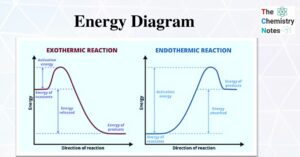
An energy diagram is often used to describe chemical reactions. These diagrams help trace the reaction’s progression from starting compounds to final products from left to right. Energy diagrams describe the physical or chemical processes of the reaction. Energy Diagram– … Read more

Isotopes – History, Types, and Uses

Isotopes

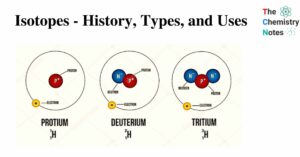
The term “isotope” refers to one of two or more species of atoms of a chemical element that share the same atomic number and position in the periodic table as well as nearly identical chemical behavior, but have different atomic … Read more

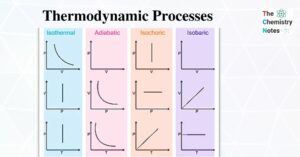
Thermodynamic Processes

Thermodynamic Processes

Thermodynamic processes are the exchanges of energy in the form of heat between or within systems. As we are already well-known for the term thermodynamics. Thermodynamics is the study of energy transfers in a system as represented by the heat, … Read more

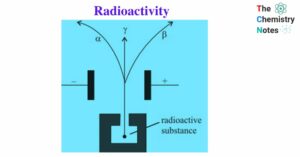
Radioactivity and radioactive series

Radioactivity

Radioactivity is the phenomenon of spontaneous disintegration of certain nuclei into other elements with the emission of invisible active radiations.  It is a natural phenomenon in which unstable atoms emit radiation to achieve stability. Discovery In 1896 Henri Becquerel discovered … Read more

Crystals and laws of crystallography

Types of unit cell

In any compound, intermolecular forces of attraction and thermal force operate in opposite directions. The intermolecular force of attraction tends to keep the particles together while the thermal force tends to keep the particles apart. The extent of these forces … Read more

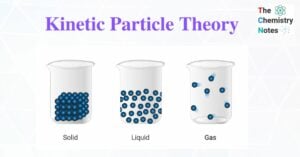
Kinetic Particle Theory

Kinetic Particle Theory

To understand the matter, one can employ the kinetic particle theory. And virtually everything around us is made of matter.  All matter is composed of numerous tiny particles that move randomly all the time. The matter is a substance that … Read more