
Introduction and Definition of Perfect Machine (Ideal Machine) in Physics
A perfect machine is the kind of machine that has no energy loss while performing a task and are 100% efficient. The contemporary world and modern discoveries are impossible without machines. But what kinds of machines do we deal with every day? We deal with real machines that consume energy when performing any task. Thus, perfect machines are only hypothetical machines. They are impossible to achieve in real circumstances.
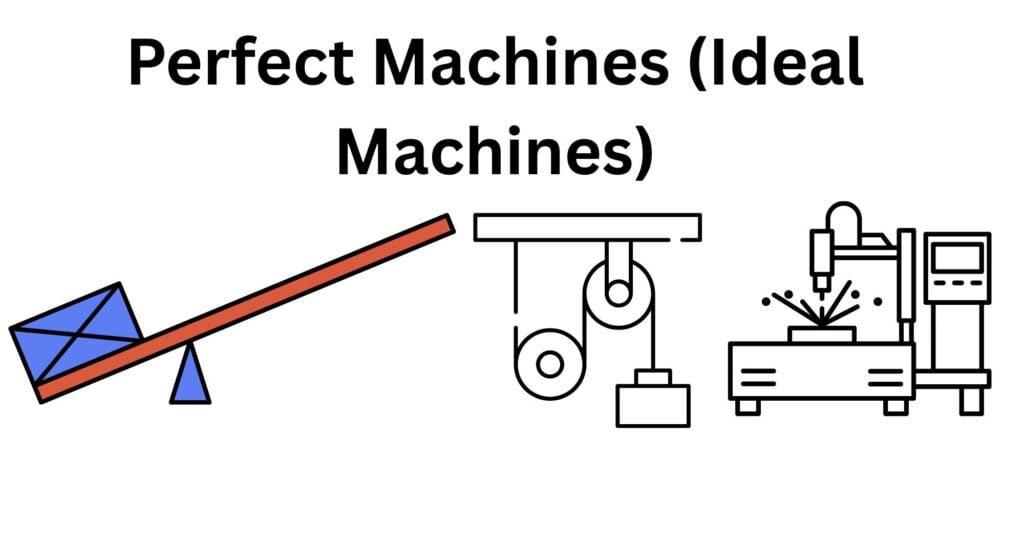
Perfect Machine (Ideal Machine)
Machines are the helping hands in any task, changing how the task is performed more easily. With the help of a machine, we can apply less effort to the same task that is difficult and time-consuming while doing it manually. The use of a machine is concerned only with making the task easier, simpler, and more convenient. Thus, the nature of the force needed to do the work is taken into account. This force either gets reduced or made convenient to apply by either changing the magnitude or the direction of the force. For example, a simple doorknob is a part of daily life, from simple tools such as levers and pulleys to complex mechanical systems. They reduce human effort and make tasks more efficient and convenient.
Among the different types of machines studied in physics, the concept of a perfect machine, also known as an ideal machine, holds special importance. In a perfect machine, the total work output is exactly equal to the total work input. In such a system, no wastage is found, and all the energy supplied to the machine is converted into useful work.
Mathematically, this can be written as:
Work Output = Work Input [Equation 1]
In real life, machines always lose some energy due to factors such as friction, heat, sound, and deformation. However, for a perfect machine, these losses are assumed to be completely absent, and such a machine is hypothetical only. It is an ideal concept used in physics to simplify analysis and to understand how machines would behave under perfect conditions.
Principle of a Perfect Machine
Perfect machines are also based on the law of conservation of energy. The simple law of physics stating that energy can neither be created nor destroyed; it can only be transformed from one form to another, is significantly implied in ideal machines.
In the case of a perfect machine, all the input energy is converted into output energy without any loss. Therefore, the work done on the machine is equal to the work done by the machine (Equation 1).
As work is the product of force and distance, it can be expressed as:
Effort × Effort distance = Load × Load distance [Equation 2]
This equation shows that the energy supplied to the machine is fully utilized in moving the load. There is no energy lost to external factors.
This principle also implies that the machine is fully imaginary and does not deal with friction or resistance. As a result, the machine gives maximum efficiency and perfect transfer of energy.
Characteristics of a Perfect or Ideal Machine
A perfect machine has some distinguishing features that make it perfect from other real-world machines. Some of the characteristics are as follows:
- A perfect machine has no energy loss. All the energy supplied as input is completely converted into useful output work. Hence, different energy losses like heat, sound vibration, etc., do not occur.
- The efficiency of a perfect machine is 1. Since no loss occurs, the machine converts all input work to the output work.
- There are no external obstructing factors like friction and air resistance. This is why the machine experiences no losses and gives 100% efficiency.
- The machine transmits energy perfectly. The material used in the machine is also perfectly smooth to transmit energy. Hence, there is no leakage.
- The quantities, mechanical advantage, and velocity ratio are also equal. This property ensures that the machine transfers energy perfectly.
- The internal parts of the machine are also perfect, with no internal wear and tear. Thus, the machine does not undergo any damage over time.
Finally, a perfect machine operates under pure hypothetical conditions. These conditions cannot be achieved in real life, but are useful for theoretical analysis.
Mechanical Efficiency of a Perfect Machine (100% Efficiency)
Mechanical efficiency is a mathematical tool to check the work transfer in the machines. It measures how efficiently the input work is converted into the output work. It is mathematically defined as the ratio of output work to input work.
Efficiency = Output Work / Input Work x 100% [Equation 3]
In a perfect machine, since the output work is equal to the input work, the efficiency becomes:
Efficiency = 100%
This is the characteristic feature of a perfect machine, illustrating that the machine suffers no energy loss. This defining property makes the perfect machines superior to real machines. This is the maximum possible energy that any machine can achieve. However, the real world is always affected by friction and resistance. Therefore, the machine remained solely theoretical.
The concept of 100 percent efficiency is important because it represents the maximum possible efficiency that any machine can achieve in theory.
Relationship Between Mechanical Advantage, Velocity Ratio, and Efficiency
Mechanical advantage, velocity ratio, and efficiency are the three main quantities to define any machine.
Mechanical advantage is defined as the ratio of load to effort.
Mechanical Advantage = Load / Effort [Equation 4]
It indicates how much the machine multiplies the applied force.
Velocity ratio is defined as the ratio of the distance moved by the effort to the distance moved by the load.
Velocity Ratio = Distance moved by effort / Distance moved by load
It shows how the distance maintained by the effort affects the load to be overcome.
Efficiency is defined as the ratio of mechanical advantage to velocity ratio.
Efficiency = Mechanical Advantage / Velocity Ratio [Equation 5]
In a perfect machine, efficiency is equal to one. Therefore:
Mechanical Advantage = Velocity Ratio
This means that the input and output are perfectly balanced, giving no chance of leakage.
In real machines, the mechanical advantage is always less than the velocity ratio because of energy losses. This results in efficiency being less than one.
Why a Perfect Machine Is Not Possible in Real Life
The concept of a perfect machine is called theoretical because in real life, it does not get its required conditions to function. There are several reasons for this, and some of them are given below:
- One of the main reasons is friction. Friction is always present in real situations when moving parts of the machine. It tries to block the motion, and some input energy gets wasted in the form of heat. This reduces the efficiency of the machine.
- Another reason is energy loss. As stated above, some energy is always lost in the form of heat, sound, and vibrations. These losses are always sure to occur as friction cannot be denied.
- Material limitations also play a role. Real materials are not perfectly rigid. They deform under stress and may absorb some energy, which is not recovered.
- Air resistance is also another factor because moving parts interact with air, which creates resistance and reduces efficiency.
- Also, no machine can be built with perfect precision. There are always small defects in the design and construction.
- Finally, according to the laws of thermodynamics, no real system can achieve 100 percent efficiency. Some energy is always lost in every process.
Perfect Machine vs Real (Practical) Machine
A perfect machine and a real machine differ in several important ways.
- A perfect machine has 100 percent efficiency, while a real machine has efficiency less than 100 percent. This is because real machines lose some energy during operation.
- In a perfect machine, there is no energy loss, but in a real machine, energy is lost due to friction, heat, and other factors.
- Friction is completely absent in a perfect machine, whereas it is always present in real machines.
- In a perfect machine, the mechanical advantage is equal to the velocity ratio. In a real machine, the mechanical advantage is less than the velocity ratio.
- A perfect machine does not experience wear and tear, but real machines do wear out over time.
- Finally, a perfect machine is only theoretical, while real machines are used in practical applications.
Examples of Ideal Machines
Although perfect machines do not exist in reality, we often try to obtain nearly perfect machines with maximum efficiency. Some examples of ideal machines are:
- An ideal lever in which there is no friction at the pivot and the lever is perfectly rigid. It transmits force without any loss.
- An ideal pulley in which the rope is weightless, and there is no friction in the pulley wheel. It changes the direction of force without energy loss.
- An ideal inclined plane has a smooth surface without friction. It allows objects to move without resistance.
- An ideal wheel and axle system that operates without friction and transmits rotational motion perfectly.
- An ideal screw has no friction between its threads and moves smoothly without energy loss.
These examples help us understand the basic principles of machines.
Applications of Ideal Machines
The concept of ideal machines has several important applications in physics and engineering.
- It is widely used in theoretical studies to simplify calculations and understand fundamental principles.
- Engineers use the concept of ideal machines as a reference to design more efficient real machines. By comparing real machines with ideal ones, they can identify areas of improvement.
- Ideal machines are also used in teaching and learning. They help students understand basic concepts without the complications of real-world factors.
- The concept is useful in analyzing machine performance and determining efficiency.
- It also plays a role in optimization, where engineers try to reduce energy losses and improve performance.
Advantages of the Perfect Machine
Being a perfect machine, it is highly useful while performing any tasks. Some of its advantages are as follows:
- It simplifies the understanding of machines by removing complex factors such as friction and energy loss.
- It provides a standard or benchmark for comparing the performance of real machines.
- It makes calculations easier by assuming ideal conditions.
- Based on the principle of conservation of energy, the law can be understood very well with perfect machines.
- It helps engineers to design machines with higher efficiency.
Limitations of Perfect Machines
Attaining perfection is a very hard, or like impossible, topic. Thus, these theoretical machines are challenging to implement. Some limitations are given below:
It doesn’t exist in reality and cannot be obtained in practice.
It doesn’t consider obstructing factors like friction, air resistance, and material properties.
It may lead to oversimplification if applied without considering real-world conditions.
It does not account for the wear and tear of materials.
Its direct application in real-life situations is limited.
Conclusion
A perfect machine is created with a significance to represent all other machines in an ideal condition. It has 100% efficiency, which is maintained under zero friction or resistance. It also works according to the law of conservation of energy, where all given input converts to output.
In real life, circumstances like friction, resistance, etc., always appear, and hence, a perfect machine is impossible to obtain. However, minimizing these factors to the lowest, we can get a nearly perfect machine with maximum efficiency. Therefore, it is very important to study and understand the ideal machine. This study plays a great role in creating engineering designs and analyzing any machines.
In conclusion, perfect machines are the reference while designing any other machines. An engineer desires to obtain a nearly perfect machine by studying its properties and hence works accordingly. Thus, perfect machines are the ideal ones that every real machine tries to achieve.
References
- https://en.wikipedia.org/wiki/Ideal_machine
- https://www.researchgate.net/publication/333347399_Ideal_Mechanization_Exploring_the_Machine_Metaphor_through_Theory_and_Performance
- https://taylorandfrancis.com/knowledge/Engineering_and_technology/Mechanical_engineering/Ideal_machine
- https://completeera.com/ideal-vs-real-machine-understanding-the-differences/
- https://www.tutorchase.com/answers/a-level/maths/what-is-the-difference-between-an-ideal-machine-and-a-real-machine
- Patterson, J. (2025). Simple Machines. Publifye AS.
- Pryce, R. (2022). 8.5 Simple Machines. Introduction to Biomechanics.
