Carbocation Stability: Definition, Factors, Order
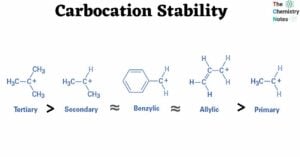
Carbocation Stability

A carbocation is a positively charged carbon atom that is cation. Carbocations are intermediates in many organic processes. They are typically unstable and short-lived, but can be sustained by resonance or nearby functional groups that can contribute electron density. Continue … Read more
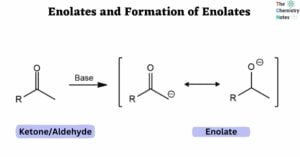
Enolates and Formation of Enolates

Enolates and Formation of Enolates

Enolates have an essential role as organic reactive intermediates. They have the properties of both alkoxide and carbanion. Enolates may be made from carbonyl compounds like aldehydes and ketones by protonating the oxygen atom and then deprotonating the alpha-carbon atom. … Read more

pKa Table of Common acids

pKa Table

The pKa value of a molecule describes its acidity. A pKa table simplifies pKa values. It determines an acid’s strength by how firmly a proton is retained by a Bronsted acid. The lower the pKa value, the more powerful the … Read more

Strong Acids and Strong Bases

Strong Acids and Strong Bases

A strong acid is one that is completely dissociated in water. H+ is a chemical species with a high potential for proton loss. A molecule with a hydrogen bonded to an electronegative atom, such as oxygen or a halogen (fluorine, … Read more

Haber’s Process: History, Advantages, Disadvantages

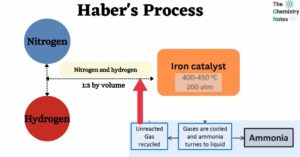
Haber's Process

The Haber’s process, commonly known as the Haber-Bosch process, is the primary industrial approach for ammonia synthesis. One of the most effective and productive industrial processes for producing ammonia is the Haber process. By combining airborne nitrogen and hydrogen, primarily … Read more

Diatomic Elements: Important 7 Elements

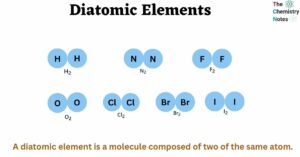
Diatomic Elements

The diatomic elements include hydrogen(H), nitrogen(N), oxygen(O), fluorine(F), chlorine(Cl), bromine(Br), and iodine(I). In nature, the diatomic elements only exist as H2, N2, O2, F2, Cl2, Br2, and I2. A molecule is formed when two or more atoms combine. Because the … Read more

Noble Gases: Properties, Applications, Effects

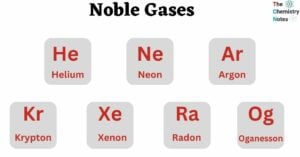
Noble Gases

Helium (He), neon (Ne), argon (Ar), krypton (Kr), xenon (Xe), oganesson (Og) and radon (Rn) are the noble gases or inert gases that make up Group 18 of the periodic table. Because of their full valence shells’ (octets’) severe nonreactivity, noble … Read more