Skip to content
Science Info
  • Home
  • Astronomy
  • Physics
  • Chemistry
    • Periodic Table
    • Analytical Chemistry
    • Basic Chemistry
    • Biochemistry
    • Computational Chemistry
    • Environmental Chemistry
    • Inorganic Chemistry
    • Nanochemistry
    • Organic Chemistry
    • Pharmaceutical Chemistry
    • Physical Chemistry
  • Biology
    • Plants
    • Animals
  • Science Facts
  • Top 10 in Science

Organic Chemistry

Organic chemistry is a branch of chemistry that examines the structure, characteristics, and interactions of organic molecules that have covalent bonds with carbon.

  • Organic chemistry is a large field due to a critical feature of the element carbon known as carbon catenation. Carbon has a remarkable ability to make extremely stable bonds with other carbon atoms, allowing it to construct stable molecules with relatively complex structures. Catenation is an element’s ability to create bonds with atoms of the same type. As a result, this characteristic of carbon can be used to explain the complexity of organic chemistry.
  • More than a million carbon compounds are known due to their ability in creating covalent bonds. Many are hydrocarbons, which are made up of simply carbon and hydrogen. The majority of hydrocarbons are derived from petroleum.
  • Jöns Jakob Berzelius, a Swedish scientist, used the term “organic” in 1807 to describe chemicals produced by living organisms. Organic molecules were once thought to be impossible to manufacture artificially because they carried a mystical essence of life known as “vital force.”
  • Friedrich Wöhler synthesized the organic chemical urea from inorganic starting materials in 1828, demonstrating that a compound synthesized by living cells could be synthesized in the laboratory without the use of biological starting materials, thus contradicting a basic tenet of vitalism.
  • The synthesis of urea represented the beginning of a new era in organic chemistry, not only redefining the term organic but also rerouting organic chemistry into a wholly new scientific subject.
  • The modern definition of organic is carbon-containing substances, which is now the scientific manner of characterizing the term. However, organic compounds have remained important to every known lifeform over the years, as an abundance of organic molecules comprise all living species.
  • Organic compounds are the foundation of all life on Earth and account for the vast majority of known substances. The variety of organic compounds is structurally complex, and their range of uses is extensive because of the bonding patterns of carbon, which has a valence of four and formal single, double, and triple bonds as well as structures with delocalized electrons.
  • Organic chemistry studies carbon-containing molecules’ structure, characteristics, content, reactions, and production. Most organic molecules comprise carbon and hydrogen but can also contain nitrogen, oxygen, halogens, phosphorus, silicon, and sulfur.
  • Organic chemistry is significant because organic compounds are the majority of the vital biological molecules in living systems. Almost all common polymers are made from organic molecules.
  • They are the foundation or ingredients of many commercial items, including pharmaceuticals, petrochemicals, and agrichemicals, as well as products made from them, such as lubricants, solvents, plastics, fuels, and explosives.
  • Organometallic chemistry, which studies carbon-based molecules including metals, and bioorganic chemistry, which integrates organic chemistry with biochemistry, are two new disciplines of organic chemistry.
  • Organic chemistry methods are applied in pharmaceutical chemistry, natural product chemistry, and materials science. Organic chemists in industry work in both discovery chemistry (creating new chemicals) and process optimization (developing better synthetic methods for large-scale production).

Isocyanides: Nomenclature, Preparation, Properties, Reactions, Uses, Toxicity
July 20, 2023 by Kabita Sharma
Isocyanides

Isocyanides, also known as Isonitriles or Carbylamines, are any of an organic compound with the molecular formula R – N ≡ C, where R is a combining group derived by the ejection of a hydrogen atom from an organic compound. So, Isocyanide … Read more
Aryl diazonium salt: Preparation, Properties, Reactions Applications

July 31, 2023July 5, 2023 by Kabita Sharma
diazonium salts

 Aryl diazonium salt is the group of organic compounds characterized by the presence of function group -N≡N-directly bonded to the aryl group Ar. They have the general formula – ArN2+ X –, where X– may be an anion like Cl–, … Read more

Nitrobenzene: Preparation, Properties, Reactions, Uses

July 4, 2023 by Kabita Sharma
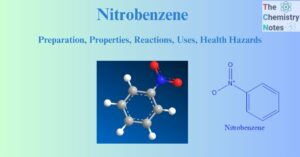
Nitrobenzene

Nitrobenzene is the most basic aromatic nitro compound, with the molecular formula C6H5NO2. Nitrobenzene was initially synthesized in 1834 by the German chemist Eilhardt Mitscherlich, who used fuming nitric acid to treat benzene. It is an oily, pale yellow, or … Read more

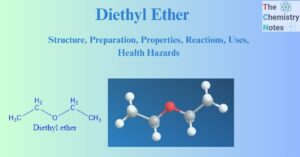
Diethyl Ether: Structure, Preparation, Properties, Reactions, Uses, Health Hazards

July 3, 2023 by Kabita Sharma
Diethyl ether

Diethyl ether, often known as ether, is an organic molecule composed of two ethyl groups connected by an oxygen atom as C2H5 – O – C2H5.  It is a well-known anesthetic and is also known as ethyl ether.  The IUPAC name … Read more

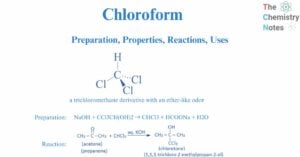
Chloroform: Structure, Preparation, Properties, Reactions, Uses, Health Hazards

July 3, 2023 by Kabita Sharma
Chloroform

Chloroform is a colorless and volatile liquid. It is a trichloromethane derivative with an ether-like odor. It is represented by the chemical formula CHCl3. The hydrogen bonded to the carbon in chloroform contributes to hydrogen bonding. Many different types of … Read more

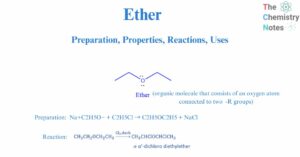
Ether: Preparation, Properties, Reactions, Uses

July 2, 2023 by Kabita Sharma
Ether

Ethers are a type of organic molecule that consists of an oxygen atom connected to two  -R groups. Alkyl, aryl, or vinyl groups can be used as R groups. They are also considered water derivatives in which both hydrogen atoms have … Read more

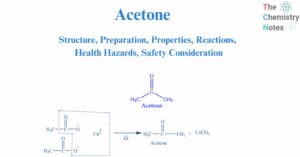
Acetone: Preparation, Properties, Reactions, Uses, Health Hazards, Safety Consideration

July 2, 2023July 2, 2023 by Kabita Sharma
Acetone

Acetone is a colorless liquid ketone that is volatile and combustible. It is the simplest and most basic aliphatic ketone, with the formula CH3COCH3.  It is also known as 2-propanone, or dimethyl ketone ad acts as an organic solvent for … Read more

Aniline: Structures, Preparation, Reactions, Properties, Uses

June 29, 2023 by Kabita Sharma
Aniline

Aniline is an aromatic derivative in which a hydrogen atom of the benzene ring has been replaced by an amino group -NH2. Aniline is also known as aminobenzene or phenylamine. It has a chemical formula of C6H7N or C6H5NH2 that contains Six … Read more

Nitro Compounds: Classification, Preparation, Properties, Reactions, Uses

June 28, 2023 by Kabita Sharma
Nitro compounds

Nitro compounds are a type of organic compound distinguished by the presence of one or more nitro functional groups (NO2) directly attached to the carbon of the hydrocarbon chain or aromatic ring. Nitro compounds are typically created via a variety … Read more

Older posts
Newer posts
← Previous Page1 … Page12 Page13 Page14 … Page20 Next →

Topics

  • Analytical Chemistry (164)
  • Animals (2)
  • Astronomy (4)
  • Basic Chemistry (144)
  • Biochemistry (38)
  • Book Reviews (1)
  • Botany (2)
  • Computational Chemistry (4)
  • Differences Between (70)
  • Environmental Chemistry (31)
  • Events (2)
  • Inorganic Chemistry (183)
  • Journals (1)
  • Nanochemistry (17)
  • Organic Chemistry (177)
  • Periodic Table (130)
  • Pharmaceutical Chemistry (15)
  • Physical Chemistry (199)
  • Physics (115)
  • Plants (13)
  • Science Facts (12)
  • Syllabus (5)
  • Top 10 in Science (14)
  • Universities (4)
  • Zoology (1)
  • Redox Reactions (A Level Chemistry Revision Notes)
  • Oxidation Numbers (A Level Chemistry Revision Notes)
  • Electrochemistry (A Level Chemistry Revision Notes)
  • Hess’s Law (A Level Chemistry Revision Notes)
  • The Gaseous State: Ideal and Real gases (A Level Chemistry Revision Notes)
  • About
  • Our Team
  • Contact Us
  • Editorial Policy
  • Privacy Policy
  • Cookie Policy
  • Disclaimer (Terms and Conditions)
© 2026 Science Info. Made with ♡ by Sagar Aryal.