Aromaticity: Huckel’s Rule and Aromatic Compounds

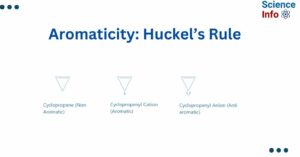
Aromaticity

Aromaticity is the property of an organic compound. Aromatic compounds have high stability. In 1931, German chemist and physicist Erich Hückel developed a theory to help determine if a planar ring molecule would have aromatic characteristics. According to his rule, … Read more

E1 Mechanism

E1 Mechanism

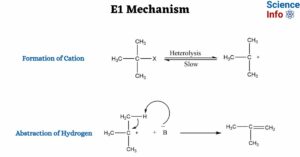
An E1 mechanism reaction, also known as unimolecular elimination, mirrors the SN1 reaction and stands in contrast to electrophilic addition. Typically a two-step process, it commonly involves tertiary alkyl halides, though select secondary ones may also participate. E1 elimination occurs … Read more

Bond Cleavage: Homolysis and Heterolysis

Bond Cleavage

Bond cleavage is the dissolution of a chemical bond (usually a covalent bond). Covalent bond fission, or covalent bond breaking, can occur in two ways: i.e., Homolytic bond cleavage and Heterolytic bond cleavage. Homolytic bond cleavage Homolysis, also known as … Read more

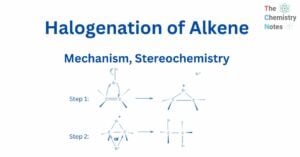
Halogenation of Alkene: Mechanism, Stereochemistry

Halogenation of alkene

Halogenation of alkene involves the addition of a halogen such as bromine or chlorine to an alkene’s double bond. Because of the polarizability of their covalent bond, halogens can act as electrophiles. Halogen addition is stereospecific, producing vicinal dihalides with anti-addition. … Read more