E1 Mechanism

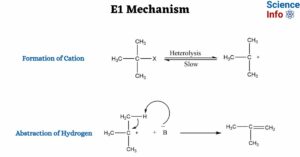
E1 Mechanism

An E1 mechanism reaction, also known as unimolecular elimination, mirrors the SN1 reaction and stands in contrast to electrophilic addition. Typically a two-step process, it commonly involves tertiary alkyl halides, though select secondary ones may also participate. E1 elimination occurs … Read more
Bond Cleavage: Homolysis and Heterolysis

Bond Cleavage

Bond cleavage is the dissolution of a chemical bond (usually a covalent bond). Covalent bond fission, or covalent bond breaking, can occur in two ways: i.e., Homolytic bond cleavage and Heterolytic bond cleavage. Homolytic bond cleavage Homolysis, also known as … Read more

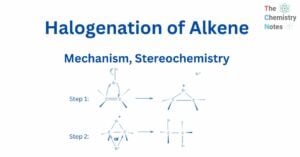
Halogenation of Alkene: Mechanism, Stereochemistry

Halogenation of alkene

Halogenation of alkene involves the addition of a halogen such as bromine or chlorine to an alkene’s double bond. Because of the polarizability of their covalent bond, halogens can act as electrophiles. Halogen addition is stereospecific, producing vicinal dihalides with anti-addition. … Read more

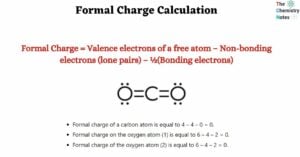
Formal Charge Calculation

Formal Charge Calculation

Formal charge calculation is significant since it is used to determine the lowest energy configuration among the different potential Lewis structures of a molecule. An atom in a molecule is given a formal charge if all of the electrons in the … Read more

General Organic Chemistry: Terms, Important Topics

General Organic Chemistry

General Organic Chemistry (GOC) introduces students to the fundamental ideas of organic chemistry. A solid comprehension of the principles covered by General Organic Chemistry is essential for studying more advanced topics (such as the mechanisms of named reactions). Berzelius (1808) … Read more

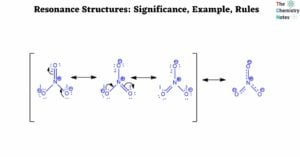
Resonance Structures: Significance, Example, Rules

Resonance Structures Significance, Example, Rules

A polyatomic ion’s or molecule’s electron delocalization is described by resonance structures. Due to the presence of partial charges and fractional bonds in a molecule/polyatomic ion, a single Lewis structure fails to describe the bonding in many circumstances. Resonance structures are … Read more

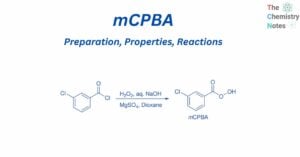
mCPBA: Preparation, Properties, Reactions

mCPBA

mCPBA (Meta-chloroperoxybenzoic acid ) is a peroxycarboxylic acid with the chemical formula C7O3H5Cl. It is a white crystalline powder with a melting point of 90 degrees Celsius. mCPBA is a powerful oxidising agent that is commonly employed as an oxidant … Read more

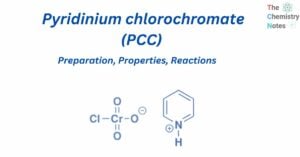
PCC: Preparation, Properties, Reactions

PCC

PCC (Pyridinium chlorochromate) is an oxidizing agent with the formula [C5H5NH]+[CrO3Cl]. It is a reagent in chemical synthesis that is mostly used to oxidize alcohols to generate carbonyls. Corey and associates first developed pyridinium chlorochromate, which is a stable orange solid … Read more