Skip to content
Science Info
  • Home
  • Astronomy
  • Physics
  • Chemistry
    • Periodic Table
    • Analytical Chemistry
    • Basic Chemistry
    • Biochemistry
    • Computational Chemistry
    • Environmental Chemistry
    • Inorganic Chemistry
    • Nanochemistry
    • Organic Chemistry
    • Pharmaceutical Chemistry
    • Physical Chemistry
  • Biology
    • Plants
    • Animals
  • Science Facts
  • Top 10 in Science

Analytical Chemistry

Analytical chemistry is the branch of science that develops and applies methods, instruments, and strategies for obtaining information on the composition and nature of matter.

  • It develops, optimizes, and applies methods of measurement to produce quality (bio)chemical information of various natural and artificial objects and systems to solve analytical challenges derived from information.
  • Analytical chemistry is not limited to any certain kind of chemical substance or reaction, in contrast to other important subfields of chemistry like inorganic chemistry and organic chemistry.
  • Geometric aspects like molecular morphologies and species distributions are examined in analytical chemistry, along with characteristics like composition and species identity.
  • The goal of analytical chemistry is to identify the qualitative and quantitative composition of substances.
  • Quantitative analysis determines the amount of various chemical components contained in a given sample.  It is concerned with determining the amount or percentage of one or more elements in a sample.
  • The qualitative analysis offers information on the chemical compound’s quality. The qualitative analysis investigates a material’s chemical composition. It demonstrates the presence of distinct elements or sets of elements in the sample, such as functional groupings.
  • A chemical analysis (wet) technique can be classed as either a classical method or an instrumental method. As a result, both qualitative and quantitative analysis is split into two categories: Classical (“wet”) analysis and instrumental analysis.
  • The classical analysis is carried out using chemical processes. It involves volumetric analysis and gravimetric analysis processes.
  • The volumetric analysis determines the volume of the known concentration solution needed to completely react with the analyte. The volumetric analysis is also known as the titrimetric analysis.
  • Gravimetric analysis is an analytical technique used for the quantitative determination of an analyte based on the mass of a solid. Using this method of analysis, the element to be detected is precipitated from a solution by the addition of a suitable precipitating agent.
  • The instrumental analysis employs instruments and relies on the physical and physicochemical properties of the substance being analyzed such as absorption or emission of electromagnetic radiation or electrical properties. So instrumental method can be further subdivided into chromatographic method, electroanalytical method, and spectroscopic method.
  • Chromatography is a process for separating a mixture of chemical substances into their components so that the individual components can be thoroughly analyzed. It is a method of separating the constituents, or solutes, of a mixture based on the relative amounts of each solute distributed between a flowing fluid stream, known as the mobile phase, and a  stationary phase. The mobile phase might be a liquid or a gas, whereas the stationary phase can be solid or liquid.
  • Electrochemical methods of analysis are based on the measurement of electrical information such as current, potential, and charge and their correlation with the chemical properties of a sample. An electrical response is produced by electrochemical reactions that take occur at the electrode-solution interface, where a tiny number of molecules in the bulk solution play a role to generate an electrical response.
  • Optical methods of analysis are often known as spectroscopic methods. All spectroscopic techniques rely on electromagnetic radiation’s interaction with the quantized energy levels of the substance. These methods examine the quantitative and quantitative properties based on emission, absorption, scattering, or a change in some property of electromagnetic radiation dependent on the kind or amount of the constituent on the sample using various approaches. These techniques are categorized according to the type of effect (emission, absorption, or scattering) or the type of electromagnetic radiation (IR, visible, x-ray).

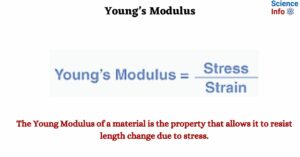
Young’s Modulus: Definition, Formula, Calculation, Application
March 15, 2024 by Jyoti Bashyal
Young’s Modulus

Young’s modulus is a mechanical property measure for linear elastic solids, such as rods, wires, and the like. It is also known as the elastic modulus or tensile modulus. The elastic properties of a solid undergoing tension or compression in … Read more
Pseudo-affinity Chromatography: Definition, Principle, Application

March 12, 2024 by Kabita Sharma
Pseudo-affinity Chromatography

In biochemistry and molecular biology, pseudo-affinity chromatography is a method used to separate and purify biomolecules based on their reversible interaction with immobilized ligands on a chromatographic substrate. The term “pseudo-affinity” describes the target biomolecule’s selective binding to the ligand; … Read more

Partition Chromatography: Definition, Principle, Procedure, Types, Application

March 11, 2024 by Kabita Sharma
Partition Chromatography

Partition chromatography is a technique primarily employed for the separation of mixture components into two liquid phases: the original solvent and the solvent coating used in the column. It is the most often-used type of liquid chromatography. The chromatographic method known … Read more

3D Printing: Working Principle, Application, Advantages, Disadvantages

March 17, 2024March 11, 2024 by Jyoti Bashyal
3D Printing

3D printing, also known as additive manufacturing, transforms production by building three-dimensional products layer by layer from digital designs. 3D printing, an additive manufacturing technique, constructs objects by layering materials without the need for molds or large material blocks. It … Read more

Fast Protein Liquid Chromatography: Features, Principle, Applications

March 10, 2024 by Kabita Sharma
Fast Protein Liquid Chromatography

Fast protein liquid chromatography (FPLC, formerly known as “fast performance liquid chromatography”) is a type of medium-pressure chromatography that was developed to purify proteins with high resolution and reproducibility. This approach employs a pump to keep the flow of the … Read more

Hydrodynamic Chromatography: Definition, Principle, and Applications

March 9, 2024 by Kabita Sharma
Hydrodynamic Chromatography

Hydrodynamic chromatography (HDC) is a technique used for separating particles based on their size, enabling the measurement of particle size distributions within the 20 – 1,000 nm range. This method expands the capability of traditional size exclusion chromatography to handle … Read more

Adsorption Chromatography: Definition, Principle, Procedure, Types, Applications

March 8, 2024 by Kabita Sharma
Adsorption Chromatography Definition, Principle, Procedure, Types, and Applications

Adsorption chromatography is a form of chromatography in which the constituents of a mixture are separated via adsorption. The process by which molecules or particles of material adhere to the surface of a liquid or solid substance known as an … Read more

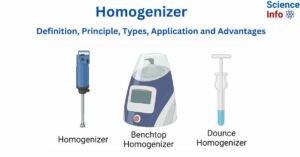
Homogenizer: Definition, Principle, Types, Application, Advantages

March 8, 2024 by Kabita Sharma
Homogenizer

Homogenizers are a kind of mixers that combine, emulsify, disperse, and dissolve liquid-liquid and solid-liquid systems by the use of mechanical forces. Homogenizers are industrial, benchtop, and laboratory instruments that are utilized in many different fields of study and industry. … Read more

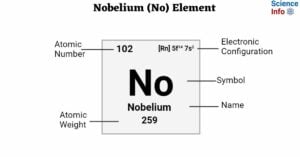
Nobelium (No) Element: Important Properties, Discovery, Uses, Effects

February 26, 2024 by Jyoti Bashyal
Nobelium (No) Element

Nobelium is a synthetic chemical element with an atomic number of 102 and is represented by the symbol ‘No’ in the periodic table. It is silvery in appearance and belongs to the f-block of period 7 of the periodic table. Nobelium … Read more

Older posts
Newer posts
← Previous Page1 … Page5 Page6 Page7 … Page19 Next →

Topics

  • Analytical Chemistry (164)
  • Animals (2)
  • Astronomy (4)
  • Basic Chemistry (144)
  • Biochemistry (38)
  • Book Reviews (1)
  • Botany (2)
  • Computational Chemistry (4)
  • Differences Between (70)
  • Environmental Chemistry (31)
  • Events (2)
  • Inorganic Chemistry (183)
  • Journals (1)
  • Nanochemistry (17)
  • Organic Chemistry (177)
  • Periodic Table (130)
  • Pharmaceutical Chemistry (15)
  • Physical Chemistry (199)
  • Physics (115)
  • Plants (13)
  • Science Facts (12)
  • Syllabus (5)
  • Top 10 in Science (14)
  • Universities (4)
  • Zoology (1)
  • Redox Reactions (A Level Chemistry Revision Notes)
  • Oxidation Numbers (A Level Chemistry Revision Notes)
  • Electrochemistry (A Level Chemistry Revision Notes)
  • Hess’s Law (A Level Chemistry Revision Notes)
  • The Gaseous State: Ideal and Real gases (A Level Chemistry Revision Notes)
  • About
  • Our Team
  • Contact Us
  • Editorial Policy
  • Privacy Policy
  • Cookie Policy
  • Disclaimer (Terms and Conditions)
© 2026 Science Info. Made with ♡ by Sagar Aryal.